RAED highlights civil society’s role at the 17th session of the Arab Ministerial Water Council
Council approves the launch of Gaza water recovery initiative and condemns the theft of Arab water resources
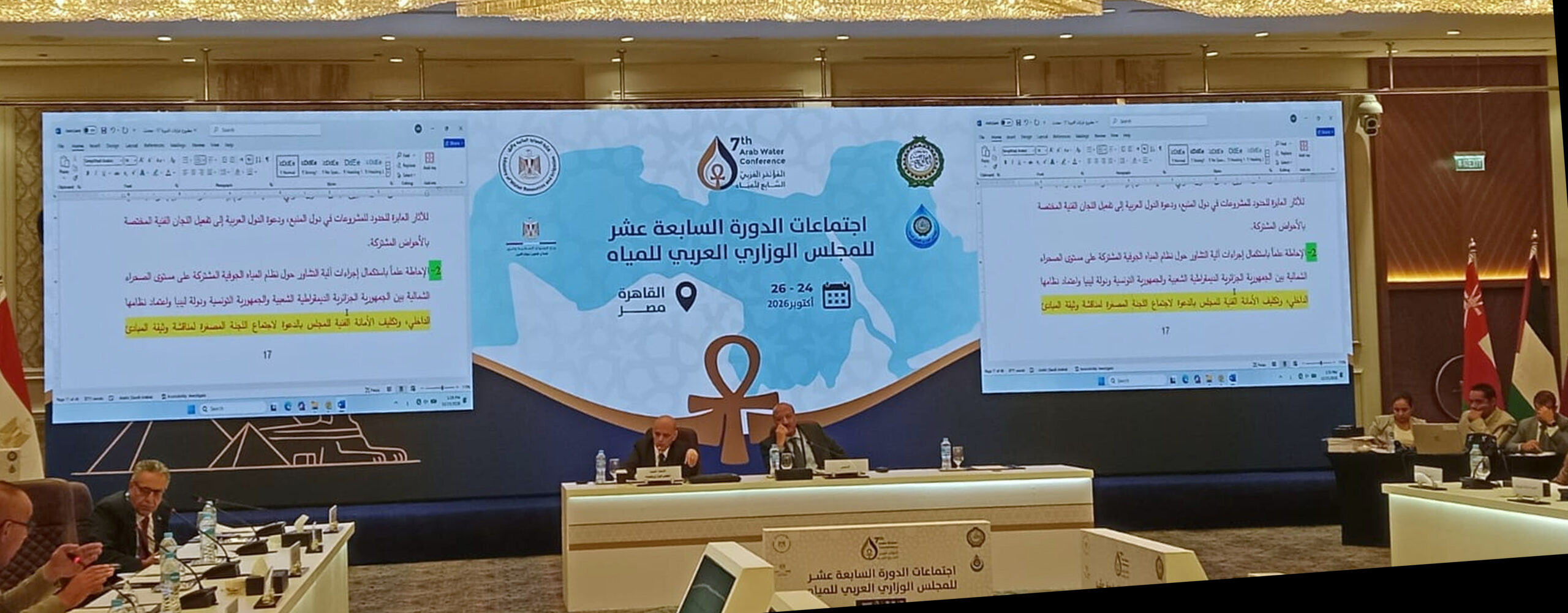
The Arab Network for Environment and Development (RAED) took part in the 17th regular session of the Arab Ministerial Water Council, held at the League of Arab States headquarters in Cairo from 24 to 29 October 2026. RAED’s participation underscored the role of civil society organisations in shaping regional water policy and tracking the implementation of strategies that affect water security and development across the Arab region.
The session came as the region prepared for two major international gatherings, the 2026 United Nations Water Conference in the United Arab Emirates and the 11th World Water Forum in Riyadh, Saudi Arabia, in 2027. RAED brought community and environmental perspectives to the discussions, highlighting how they can inform government efforts to address growing water scarcity and the accelerating impacts of climate change.
The Council adopted new mechanisms to track the implementation of its plan for the next phase in cooperation with partner organisations and civil society institutions. It also called for greater use of regional knowledge platforms and continued support for regional initiatives, including the Arab Initiative for Technological Adaptation to Climate Change and the Regional Climate Security Network.
Ministers endorsed the key messages from the regional preparatory meeting in Amman as the common Arab position for the UN Water Conference, scheduled to take place in Abu Dhabi in December 2026. The Council backed the organisation of Arab side events and called for continued coordination to bring the region’s priorities into discussions under the International Decade for Action on Water.
The Council strongly condemned what it described as Israeli violations involving the theft of Arab water resources and the destruction of water infrastructure in Palestine, the occupied Syrian Golan and southern Lebanon. It agreed to mobilise financial and technical support for the emergency response plan and the Palestinian Water Authority.
The Council approved the launch of the Arab Initiative for Water Recovery in the Gaza Strip to rehabilitate damaged water facilities and bring them back into operation. It also reaffirmed its support for Iraq’s position in seeking equitable agreements in the Tigris and Euphrates basins.
Ministers called for greater use of non-conventional water sources, including treated wastewater and brackish water, and wider adoption of digital tools and artificial intelligence. The Council also called for an Arab roadmap for digital transformation and cybersecurity in water utilities.
The session saw the launch of the second phase of the Arab Initiative to Mobilise Climate Finance for Water. Work also began on a regional platform to nominate and track bankable Arab projects, with the aim of encouraging Arab and international institutions to increase the region’s share of green finance. The Council was briefed on efforts to support water infrastructure in Sudan, including the reconstruction of the Arbaat Dam, and welcomed the assistance provided.
RAED stressed that closing the region’s water gap and responding to climate change require active participation from communities and civil society. It called for the Council’s decisions to be carried through in tandem with community initiatives and public awareness efforts led by civil society networks. RAED said this approach would strengthen water governance, promote equitable access to water and help communities protect their water resources for future generations.