RAED Highlights the Role of Civil Society Networks in Advancing Sustainable Development Goals and Disaster Risk Reduction
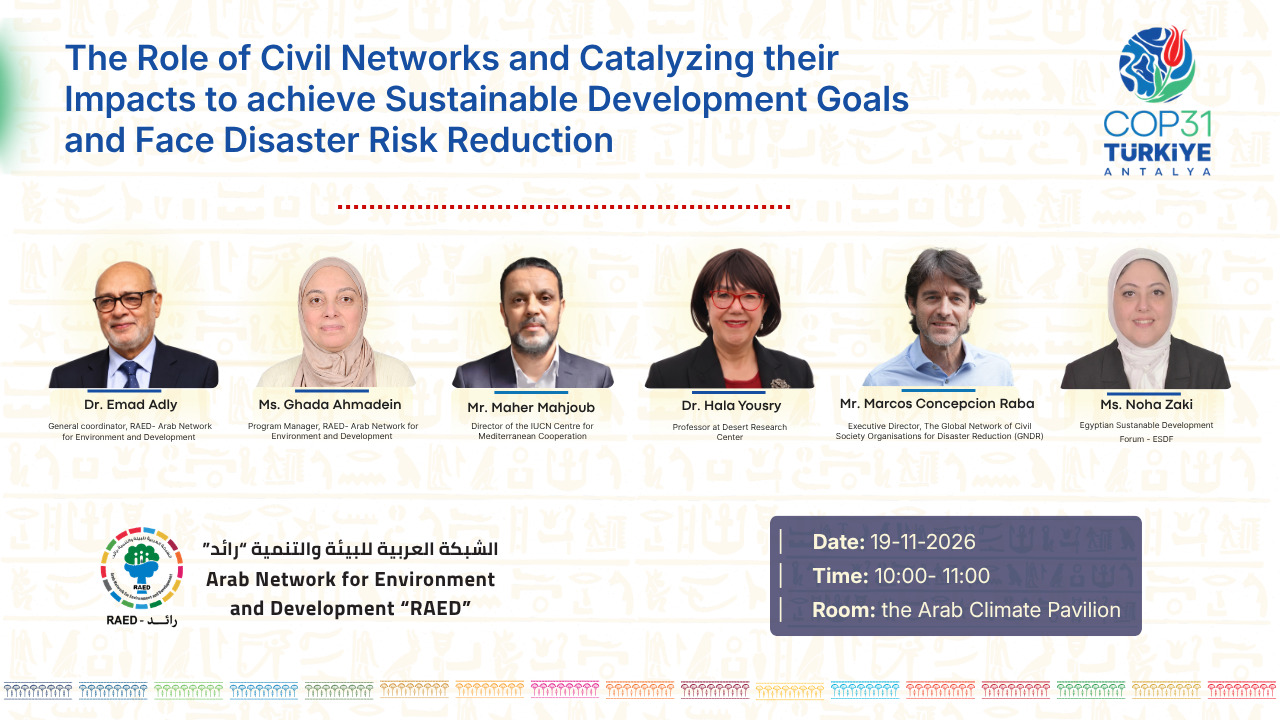
The Arab Network for Environment and Development (RAED) organised a session on 19 November during the 31st Conference of the Parties to the United Nations Framework Convention on Climate Change (COP31) in Antalya, Türkiye, examining the role of civil society networks in advancing the Sustainable Development Goals (SDGs) and strengthening disaster risk reduction. The session focused on building institutional partnerships, expanding collective action and integrating the efforts of civil society organisations across the Arab region.
The session explored the importance of moving from individual initiatives and isolated institutional efforts towards more effective civil society networks capable of influencing public policy, coordinating action and strengthening participation in implementing the SDGs. This shift comes amid increasingly complex environmental and development challenges across the Arab region, where climate change, water scarcity, food security, the energy transition, desertification, disaster risk reduction, poverty and social justice are closely interconnected.
Discussions emphasised that no single institution, organisation or sector can address these challenges alone. They require broad cooperation among stakeholders and a transition from fragmented initiatives to organised collective action, strengthening collaboration among government institutions, civil society organisations, experts, academics, media professionals, young people, local communities and the private sector.
The session highlighted civil society networks as a cornerstone of cooperation, with a role extending beyond implementing local projects. By establishing structured platforms that bring stakeholders together around shared goals, these networks facilitate the exchange of knowledge and experience, coordinate regional efforts, mobilise resources, build capacities, develop joint initiatives and bring local communities’ voices into decision-making processes.
This approach is particularly relevant to the Arab region, where countries share many environmental, climate and development challenges despite differences in national and local circumstances. Regional networks provide an important means of sharing successful experiences across borders, connecting community initiatives with regional and international agendas, and turning individual successes into collective knowledge that can be scaled up and applied elsewhere.
RAED presented its longstanding experience in building civil society networks since its establishment in 1990 during preparations for the Earth Summit. It outlined its role in strengthening institutional links among Arab civil society organisations, developing cooperation mechanisms, building the capacities of non-governmental organisations and supporting regional integration in environmental protection and sustainable development.
Examples presented included support for the Arab Network of National Sustainable Development Forums, in cooperation with the Sustainable Development Department of the League of Arab States, as platforms for multi-stakeholder dialogue and policy coordination. The session also covered the development of environmental media networks, strengthening journalists’ capacities to report on climate and environmental issues, and the use of solutions journalism, data journalism and modern digital tools.
The session also examined RAED’s experience in strengthening coordination among civil society organisations working on disaster risk reduction through its participation in the North Africa and West Asia Regional Advisory Group of the Global Network of Civil Society Organisations for Disaster Reduction (GNDR). It further highlighted RAED’s role in supporting regional environmental cooperation through the BlueGreen platform, in partnership with the Union for the Mediterranean, and its participation in the PPI-OSCAN programme to support emerging civil society organisations and strengthen their capacities and partnerships in biodiversity and sustainable development.
Participants discussed ways to develop civil society networks from platforms for information exchange into active bodies that drive collective action and formulate joint regional initiatives. Discussions also addressed strengthening their engagement with governments and regional and international institutions, and localising the SDGs within communities. Challenges examined included sustainable funding, weak coordination, overlapping initiatives, fragmented data, impact measurement and ensuring that networks remain active beyond short project cycles.
RAED’s participation forms part of its efforts to strengthen recognition of the strategic role of civil society networks in advancing the Arab sustainable development agenda. These efforts include documenting successful experiences, developing guiding principles for more effective and sustainable networks, and identifying opportunities for cooperation among existing networks. Together, they aim to strengthen knowledge exchange and increase Arab civil society’s participation in international environmental agreements and SDG follow-up processes.