RAED Announces Six Winners of TeraMED Media Competition
Dr. Emad Adly: Media is a key partner in supporting efforts to accelerate the transition to clean energy
The Arab Network for Environment and Development (RAED) has
announced the winners of the environmental media competition organized under
the project “Enhancing Strategic Advocacy for Renewable Energy in Egypt,” as
part of the TeraMED Initiative. The competition aimed to encourage journalists
and media professionals to produce professional and specialized coverage of
renewable energy and sustainability issues.
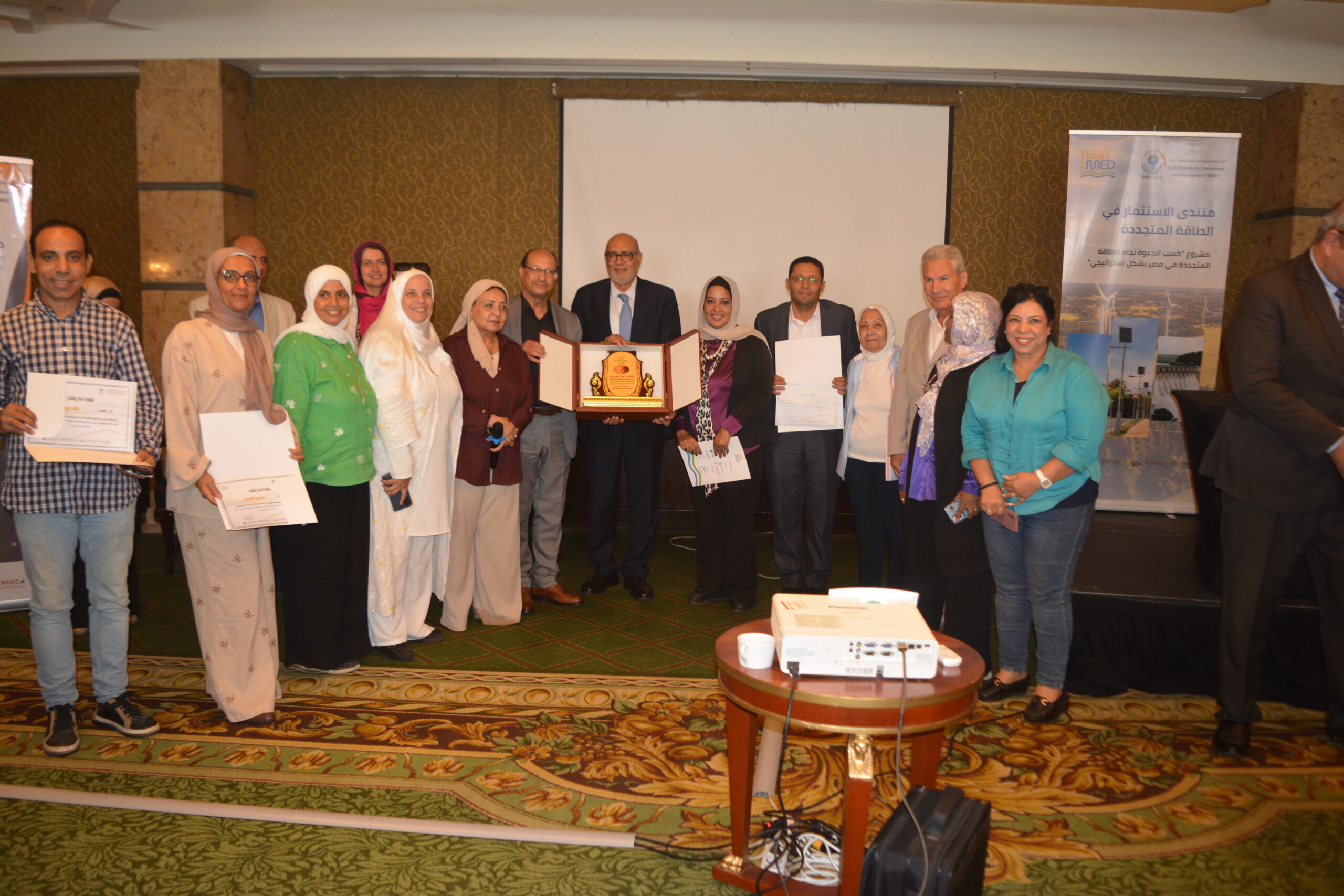
Six journalists shared the top three awards. Dr. Sherine
Ehsan, from Negoom Masrya, and Sherine Sami, from Al Alam Al Youm,
jointly received the first prize. Hind Saeed, from the Middle East News
Agency (MENA), and Hanan Fikry, from Watani, received the second
prize, while Khaled Abdelrasoul, from Al Watan, and Khaled Warby, from Arab
Finance, received the third prize.
The winners were announced during the Investment Forum to
Advance the TeraMED Initiative toward Sustainable Energy Transition and its
accompanying exhibition. The forum and exhibition aimed to strengthen dialogue
and cooperation among government entities, the private sector, civil society,
financial institutions, renewable energy service and solution providers,
experts, and specialists. They also provided a platform to explore investment
opportunities, financing options, and available mechanisms for supporting
renewable energy projects and applications.
Dr. Emad Adly, General Coordinator of RAED, said the TeraMED
media competition was part of the network’s efforts to strengthen the presence
of renewable energy and sustainability issues in the media landscape.
He emphasized the important role of the media in raising
public awareness of the transformation taking place in the energy sector,
highlighting the opportunities offered by clean energy, and addressing the
challenges facing the transition through professional reporting based on
accurate information, data, and reliable sources.
“Media is a key partner in supporting efforts to accelerate
the transition to clean energy,” Adly said, stressing the importance of
developing high-quality media content that goes beyond presenting information
to explain changes within the energy sector, highlight successful models and
initiatives, and create space for discussion around the policies and measures
needed to accelerate the clean energy transition.
He explained that the winning entries were selected
following an assessment based on a set of professional criteria. These included
the relevance of the topic to renewable energy and sustainability, its
importance and potential impact within the Egyptian context, as well as
accuracy, balance, objectivity, and the quality of language and presentation.
The judging criteria also focused on the depth of reporting
and analysis, originality of the idea and approach, the ability to engage
audiences, contribute to raising public awareness, stimulate societal dialogue,
and influence decision-makers. The use of data, statistics, studies, expert
opinions, and reliable sources to support the content was also taken into
consideration.
The competition’s jury was chaired by Dr. Mohamed El-Khayat,
former Chairman of the New and Renewable Energy Authority (NREA). The jury also
included Dr. Mahmoud Bakr, Chairman of the Society of Writers on Environment
and Development; journalist Mahmoud El-Essawy, Editor-in-Chief of Josour
2030; Rehab Abdelmohsen, Communications Officer for the TeraMED Initiative;
and Eng. Asmaa Fouad Shehab, from the New and Renewable Energy Authority.
The competition forms part of RAED’s broader efforts to
strengthen the media’s role in highlighting renewable energy and sustainable
development projects, raise public awareness of the importance of the
transition to clean energy, and showcase successful local models and
initiatives in support of societal dialogue on the future of energy in Egypt.
This approach reflects the understanding that energy transition is not driven solely by technology, investment, and policy. It also requires professional media capable of explaining the transition, discussing its challenges, highlighting its opportunities, and connecting energy issues with citizens’ lives and sustainable development priorities.