TeraMED Forum Sets Roadmap for Financing Egypt’s Renewable Energy Transition
Adly: Investment partnerships are essential to achieving clean energy targets, as experts highlight financing gaps and the need for stronger public–private cooperation
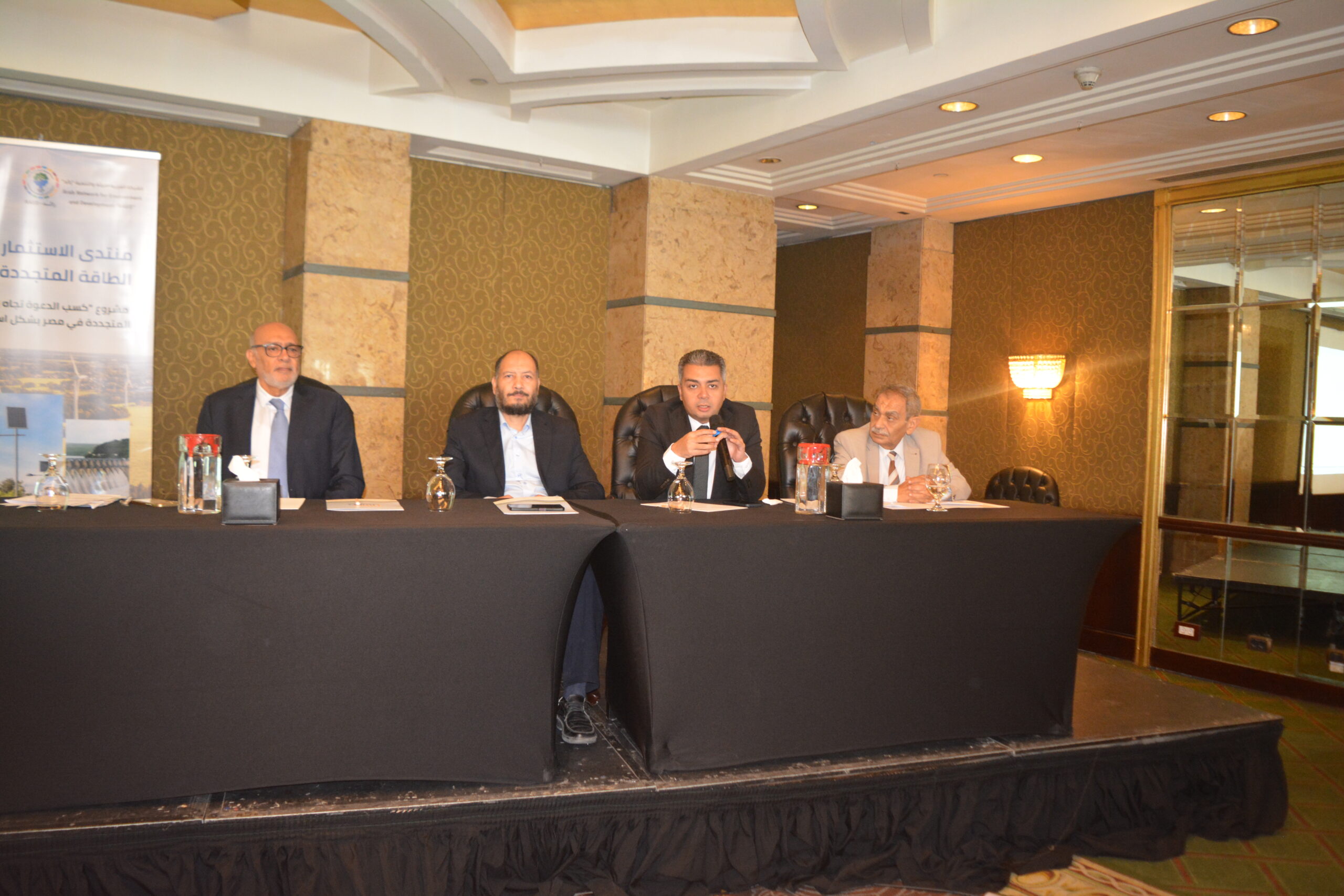
The Arab Network for Environment and Development (RAED) organized the TeraMED Investment Forum for Advancing the Sustainable Energy Transition in Cairo under the project “Strategically Advancing Advocacy for Renewable Energy in Egypt.”
The forum focused on accelerating Egypt’s renewable energy transition, expanding green investment, mobilizing finance for clean energy projects, and localizing industries related to solar energy, batteries, and technological solutions.
The event brought together representatives of government institutions, banks, research organizations, the private sector, and civil society, including the New and Renewable Energy Authority, the Ministries of Electricity and Renewable Energy, Local Development and Environment, Agriculture, and Planning, the Desert Research Center, banks, financing institutions, and entities supporting small and medium-sized enterprises.
Government Support and Investment Opportunities
The first session, “The Government Sector and Opportunities to Support the Green Energy Transition,” was chaired by Dr. Emad Adly, General Coordinator of RAED.
Adly stressed that national and regional renewable energy targets cannot be achieved through isolated efforts, emphasizing the importance of cooperation among governments, the private sector, financial institutions, and civil society.
He explained that the TeraMED Initiative seeks to mobilize efforts across the northern and southern Mediterranean, particularly Arab Mediterranean countries, toward increasing installed renewable energy capacity to a total of one terawatt.
The initiative works through two tracks: a national track focused on improving the investment and consumer environment and increasing reliance on renewable energy, and a regional track that strengthens the role of civil society in facilitating national and regional dialogue and coordinating energy-transition efforts.
Adly also highlighted Egypt’s target of increasing the share of renewable energy in the energy mix to 45% by 2028, describing it as an opportunity to expand clean energy investment and private-sector participation. He stressed the importance of addressing investor challenges, including issues related to net metering and their impact on project feasibility and access to consumers.
Financing Mechanisms for the Energy Transition
Dr. Mohamed Moatamed, Assistant Minister of Local Development and Environment for Planning and Investment, reviewed Egypt’s legislative and institutional support for the energy transition, from Egypt Vision 2030 to the National Climate Change Strategy 2050.
He highlighted incentives that give renewable energy, energy transition, and green hydrogen projects priority access to the Golden License and other investment benefits.
Moatamed also presented existing financing mechanisms, including the Egyptian Pollution Abatement Project, which has provided more than EUR 300 million in financing and contributed to investment projects worth over EUR 550 million.
Other mechanisms discussed included the Revolving Loan Fund for energy-efficiency systems and the Voluntary Carbon Market, which aims to generate additional financial flows for facilities achieving measurable emissions reductions.
Localizing Renewable Energy Industries
Dr. Amr Abdel Latif, Head of the New and Renewable Energy Department at the Desert Research Center, addressed renewable energy investment opportunities in Egypt’s desert areas, which cover more than 90% of the country’s land area.
He noted that solar-powered pumps have become a major driver of renewable energy demand in arid regions, particularly in Sinai and the New Valley Governorate.
Abdel Latif presented a roadmap for localizing solar energy components, including the use of locally available silicon, the establishment of silicon component production lines in New Alamein, expanded local manufacturing of direct-current cables and metal structures, increased assembly of power conversion equipment, and the development of a domestic lithium battery industry for electric vehicles.
He also called for stronger connections between agricultural production areas, groundwater wells, electricity transmission networks, and high-speed rail infrastructure.
According to Abdel Latif, the New Valley Governorate has more than 4,000 wells, each requiring between 100 and 150 kilowatts. He said currently available financing covers only around one-third of immediate needs, highlighting the importance of greater public–private sector integration.
Green Finance and the Banking Sector
The second session, “Green Financing Opportunities and Challenges in the Banking Sector,” was chaired by Dr. Mohamed El-Khayat, former Executive Chairman of the New and Renewable Energy Authority and member of the Board of Trustees of the Egyptian Sustainable Development Forum.
Participants included Kamel Shehata, representing the Commercial International Bank; Tamer Badr Ali, representing the National Bank of Egypt; Mohamed Shawky, Head of Small and Medium Enterprises at the Agricultural Bank of Egypt; and Noura Abdel Latif, Director of the Central Credit Department at the Micro, Small and Medium Enterprise Development Agency.
The discussion examined financing opportunities and challenges for renewable energy projects, the role of banks and financing institutions in supporting green projects, particularly SMEs, and mechanisms to attract investment and strengthen public–private partnerships.
From Challenges to Investment Opportunities
The third session, “From Challenges to Opportunities: A Roadmap for Green Energy Financing,” was chaired by Eng. Ayman Hiba, Chairman of the Sustainable Energy Division at the Cairo Chamber of Commerce and member of the Board of Trustees of the Egyptian Sustainable Development Forum.
The session included Dr. Hend Farouh, Director of the Architecture and Housing Institute at the Housing and Building National Research Center and Head of the Central Unit for Sustainable Cities and Climate Change at the Ministry of Housing; Dr. Maged Karam, Executive Director of the Regional Center for Renewable Energy and Energy Efficiency; former Senate member Noha Zaki; and Eng. Ahmed Kamal, Executive Director of the Environmental Compliance Office at the Federation of Egyptian Industries.
Discussions focused on the role of innovation and technology in accelerating the clean energy transition and the importance of aligning technological solutions with market needs to create new opportunities in renewable energy and energy efficiency.
The forum concluded by discussing a roadmap to improve financing flows, remove obstacles facing the private sector, and turn energy-transition challenges into investment opportunities.
The discussions underscored the importance of stronger cooperation among government, the private sector, the banking sector, and civil society. They also highlighted that Egypt’s renewable energy transition requires not only increased generation capacity, but also stronger financing mechanisms, technology localization, domestic industrial development, and an enabling investment environment capable of translating clean energy targets into sustainable economic opportunities.