RAED and AOYE Joint Session Explores Integrated Solutions to Strengthen Food Security and Climate Resilience
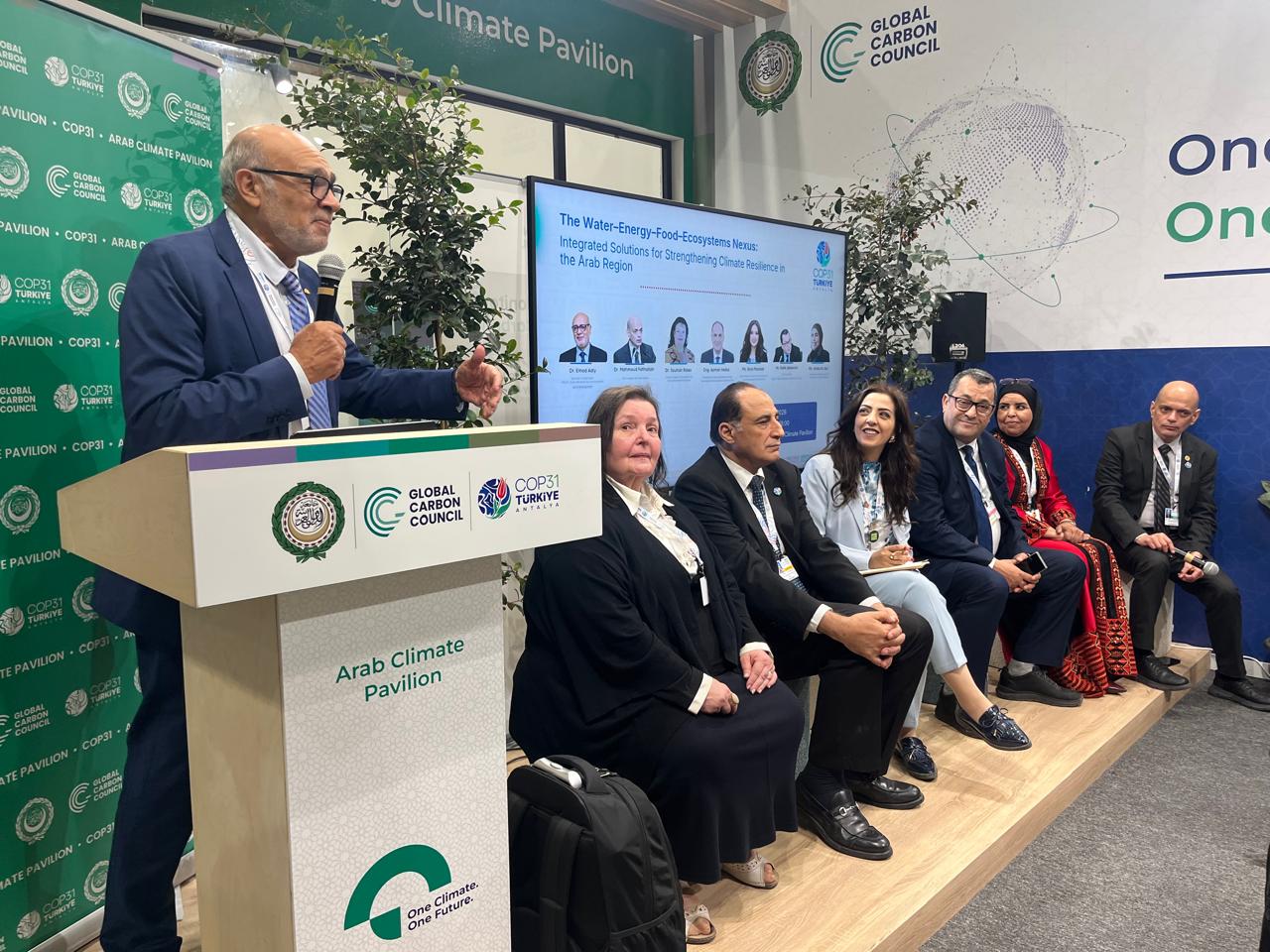
As part of Arab participation in the 31st Conference of the Parties to the United Nations Framework Convention on Climate Change (COP31), hosted in Antalya, Türkiye, the Arab Network for Environment and Development (RAED), in cooperation with the Arab Office for Youth and Environment (AOYE), organised a joint session on 18 November to explore integrated solutions for strengthening food security and climate resilience in the Arab region. The session focused on the Water–Energy–Food–Ecosystems (WEFE) Nexus as a strategic framework for managing natural resources and advancing sustainable development.
Held at the Arab Climate Pavilion with the participation of the League of Arab States, the session addressed mounting challenges facing Arab countries, including water scarcity, energy security, food security and land degradation. These challenges are being exacerbated by climate change, rising temperatures, recurring droughts and dwindling water resources, alongside growing pressures on agricultural systems and ecosystems.
The session built on RAED’s and AOYE’s national and regional experience in climate action, water, desertification, renewable energy and food security, as well as their participation in regional and international dialogue on implementing the nexus approach in the Arab region. Their engagement seeks to translate the concept from a theoretical framework into a practical tool for planning, decision-making, project design and partnership development, tailored to the circumstances of Arab countries and drought-affected areas.
Discussions highlighted the importance of applying the nexus approach in a region facing high levels of water stress, rising demand for energy and food, and expanding desertification and land degradation. These interconnected pressures call for a shift from addressing crises individually towards an integrated governance model that tackles their root causes and accounts for interactions across sectors.
Participants emphasised the need to move beyond separate sectoral policies for water, energy and agriculture. Given the close links between these sectors, decisions in one can have significant implications for the others, making integrated planning, decision-making and resource management essential.
The session explored ways to advance the practical application of the nexus approach as an integrated framework for resource governance, strategic planning and climate resilience. Discussions covered knowledge and experience sharing, practical solutions, institutional governance arrangements and financing mechanisms. They also highlighted the roles of civil society, the private sector, academic institutions and local communities in developing projects that can be implemented, financed and scaled up.
Participants examined how to shift from separate sectoral management to nexus-based management by incorporating the approach into national development plans and climate strategies, strengthening coordination among ministries responsible for water, energy and agriculture, and developing mechanisms to assess cross-sector impacts before projects are implemented.
Discussions also addressed ways to make the most of available resources amid water scarcity. These included improving water-use efficiency; safely and sustainably reusing treated wastewater in agricultural production; using renewable energy for water pumping, treatment and desalination; improving irrigation efficiency; reducing losses in water conveyance and distribution networks; using non-conventional water sources; and converting agricultural waste into energy.
The session highlighted the role of renewable energy in strengthening integration between water and agriculture through the wider use of solar-powered irrigation and water pumping, the integration of clean energy into water treatment and desalination plants, the development of energy storage solutions, and more efficient energy use in irrigation networks. These measures can help reduce operating costs and carbon emissions, while requiring careful consideration of the risks associated with uncontrolled groundwater extraction.
Participants also explored ways to strengthen climate-resilient agriculture, including expanding the cultivation of drought- and salt-tolerant crops, adopting climate-smart agricultural practices, developing hydroponic and other soilless cultivation systems where viable, and using precision irrigation technologies and artificial intelligence. Discussions also covered reducing food loss and waste, sharing successful local experiences and scaling them up across the region, documenting lessons learned, and strengthening knowledge exchange among Arab countries.
The session underscored the importance of strengthening partnerships among regional and international institutions, universities and research centres, the private sector, civil society organisations and Arab networks. Such cooperation can bring together scientific, practical, financial and community expertise to develop workable solutions tailored to the Arab region’s needs.