Expanded Seminar Introduces the Role of the TeraMED Initiative in Promoting the Transition to Clean Energy in Alexandria
The Arab Network for Environment and Development (RAED) and the Egyptian Sustainable Development Forum (ESDF), through the Local Sustainable Development Forums in the governorates, continue their joint efforts to promote the transition towards sustainable energy and raise awareness of energy efficiency and renewable energy concepts. These efforts come within the framework of a strategic partnership aimed at supporting sustainable development and climate action pathways at the local level.
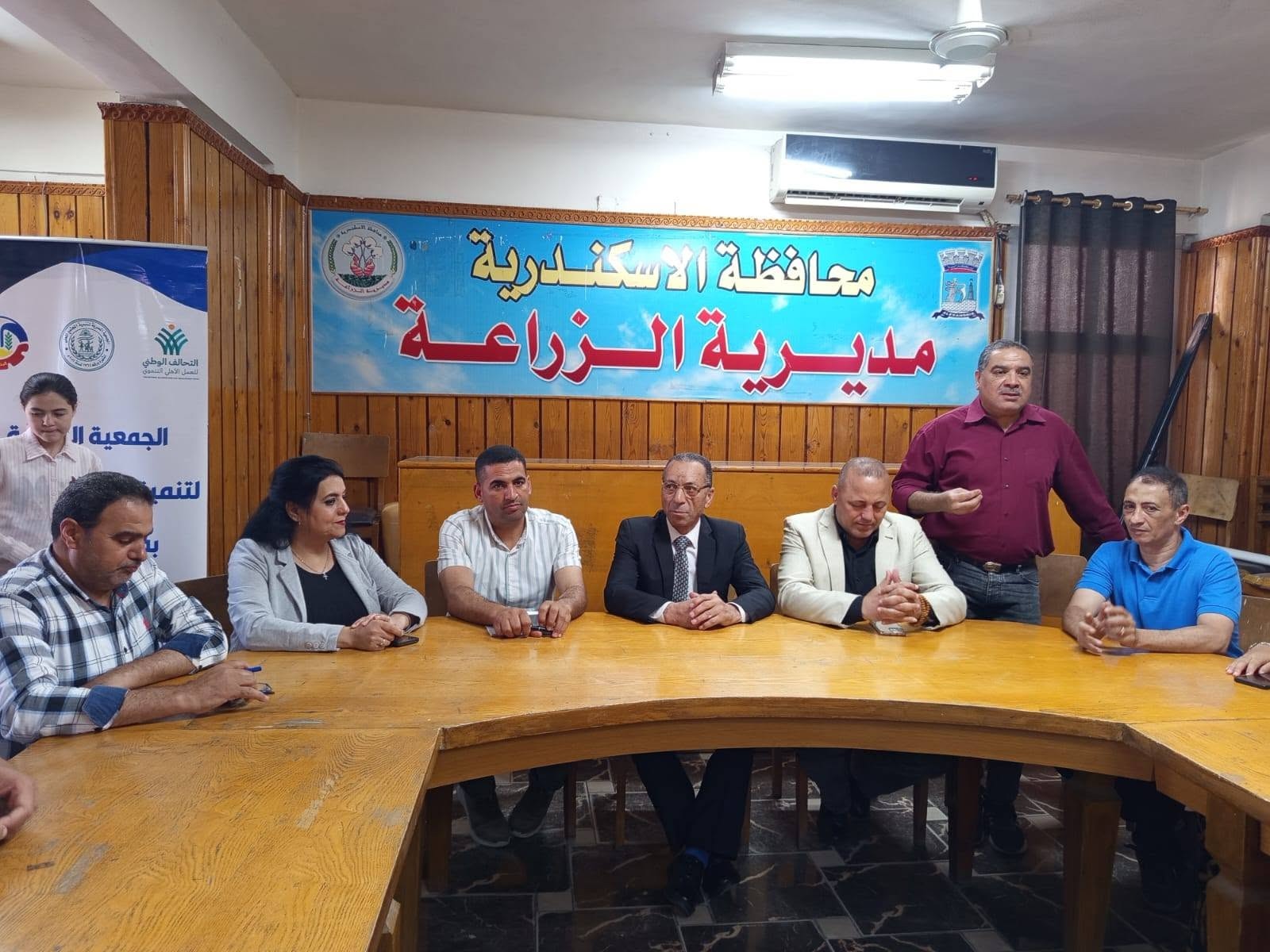
In this context, Alexandria Governorate witnessed the organization of an expanded awareness seminar to introduce the TeraMED Initiative, which seeks to support a just and sustainable energy transition in the Mediterranean region and promote greater reliance on renewable energy sources. The event brought together representatives of governmental and executive bodies, academic institutions, and civil society organizations.
The seminar was held under the auspices of Dr. Maya Morsy, Minister of Social Solidarity, and within the framework of the directives of Dr. Jacqueline Azar, Governor of Beheira, under the supervision of Dr. Fayza Zayed, Director of the Directorate of Social Solidarity in Beheira. This reflects the growing interest in supporting community-based initiatives aimed at enhancing energy efficiency and rationalizing the consumption of natural resources.
The seminar was organized by the Egyptian Association for Local Community Development in Kafr El-Dawwar, coordinator of the Local Sustainable Development Forum in Beheira Governorate, chaired by Dr. Hany Mohamed Habiba, in cooperation with the Alexandria Directorate of Agriculture. It was attended by a number of executive leaders, experts, and specialists in the fields of energy and sustainable development, including Dr. Ayman Hamouda, Undersecretary of the Ministry of Agriculture in Alexandria, and Eng. Teresa Saad, Director General of Agricultural Extension in Alexandria, alongside representatives of civil society organizations and the public and private sectors.
In his opening remarks, Dr. Ayman Hamouda emphasized the importance of expanding the use of new and renewable energy in line with the Egyptian State’s efforts to rationalize energy consumption and achieve sustainable development. He also praised the role of the Egyptian Association for Local Community Development, in coordination with the Local Sustainable Development Forum in Beheira Governorate, in implementing development and environmental initiatives.
For his part, Dr. Hany Habiba reviewed the key activities and initiatives implemented by the Association in partnership with the Local Sustainable Development Forum. He commended the pivotal role played by the Arab Network for Environment and Development (RAED), chaired by Dr. Emad El-Din Adly, in supporting efforts to achieve the Sustainable Development Goals and in building effective partnerships between civil society organizations and governmental bodies.
He explained that the TeraMED Initiative is one of the important regional initiatives led by RAED to promote a sustainable energy transition by supporting the expansion of renewable energy use, encouraging the adoption of decentralized energy solutions, and strengthening green financing mechanisms. These efforts contribute to building an integrated national vision that supports the transition towards a low-emission economy that is more resilient to climate challenges.
During the seminar, Eng. Salama Abdel Kawy, Energy Conservation Manager at Beheira Electricity Distribution Company, delivered a detailed presentation on the current state of Egypt’s energy sector, electricity generation sources, and the contribution of each source to the national energy mix. He also addressed the main challenges facing efforts to improve energy efficiency and the proposed solutions to overcome them. He affirmed that the Egyptian State attaches strategic importance to the issue of rationalizing energy consumption, considering it one of the fundamental pillars of achieving economic and environmental sustainability.
He explained that the government has adopted a set of policies and measures aimed at improving electricity use efficiency and achieving a balance between production and consumption, thereby reducing economic costs and maximizing the use of available resources. He stressed that the success of these efforts requires broad community participation and increased awareness of the importance of adopting rational consumption patterns, emphasizing that energy conservation is a shared responsibility among the State, citizens, and all institutions of society.
The seminar witnessed broad participation from representatives of executive bodies, industrial entities, vocational training institutions, and civil society organizations. Participants discussed a number of successful experiences and projects in the field of renewable energy, as well as opportunities to expand their application at the local level. They also addressed the challenges that still hinder the wider adoption of clean energy solutions in certain sectors.
Participants emphasized the important role played by civil society organizations in supporting the transition towards sustainable energy through awareness-raising, capacity-building, and strengthening local partnerships. Such efforts contribute to achieving the Sustainable Development Goals, reducing carbon emissions, and improving the quality of life of local communities.
The seminar concluded by reaffirming the continuation of cooperation between the Arab Network for Environment and Development (RAED) and the Egyptian Sustainable Development Forum (ESDF) through the Local Sustainable Development Forums in various governorates. This partnership represents an effective model for unifying civil society efforts in support of a just energy transition, expanding development and environmental initiatives, and enhancing the contribution of local communities to achieving the Sustainable Development Goals and Egypt’s future vision for the transition towards a green economy.