RAED Calls for Stronger Civil Society Role in Disaster Risk Management at Regional Forum in Tunisia
Institutional partnerships, sustainable funding for local associations and an integrated approach to turning early warnings into effective action
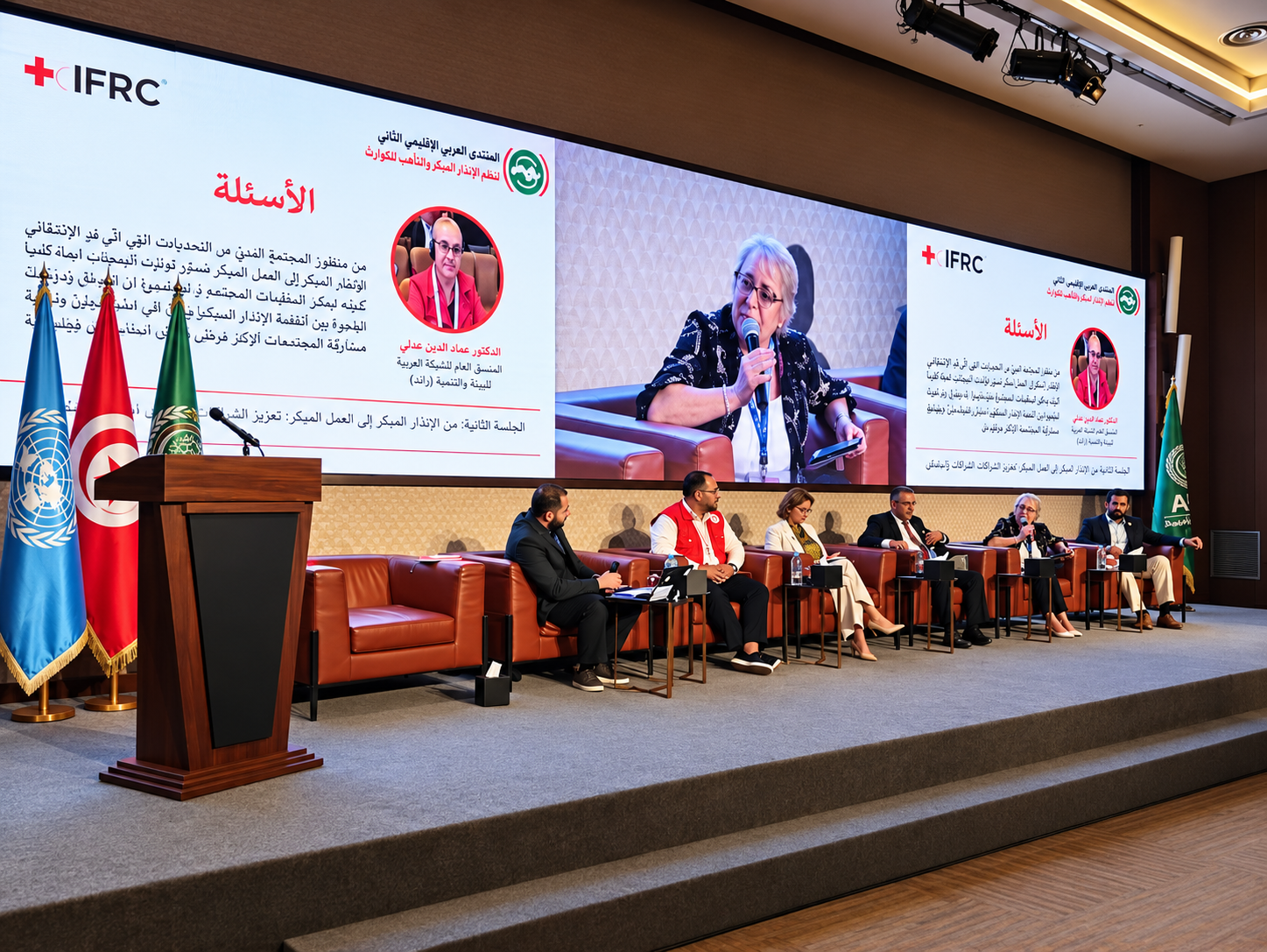
The Second Arab Regional Forum on Early Warning Systems and Disaster Preparedness concluded in Tunisia, with active participation from the Arab Network for Environment and Development (RAED), represented by Dr. Emad Adly, the General Coordinator, and Dr. Najwa Bouraoui, RAED’s National Coordinator in Tunisia and President of the Association for Environmental Protection and Sustainable Development in Bizerte.
Held over three days under the theme “Early Warnings for All,” the forum coincided with the International Day for Disaster Risk Reduction. Organised by the Arab States Broadcasting Union, it brought together representatives of Arab countries, organisations, regional and international partners, and a range of experts and specialists.
The closing statement called for prioritising the development of early warning systems and addressing existing gaps, particularly in the most vulnerable areas. It highlighted the need to strengthen disaster risk knowledge; improve monitoring, analysis and forecasting capabilities; enhance mechanisms for issuing and disseminating warnings; and increase communities’ readiness to respond.
Participants stressed the importance of integrating disaster risk reduction into educational curricula, shifting from delayed responses to proactive approaches, allocating national emergency budgets, building local community capacities, and updating legislative and regulatory frameworks. They also emphasised the need to treat multi-hazard early warning systems as a strategic investment, ensure that warnings translate into practical and effective action, and strengthen the media’s role in raising risk awareness.
Against this backdrop, Dr. Najwa Bouraoui presented RAED’s vision for strengthening Arab civil society’s role in addressing disasters, contributing to response efforts and supporting recovery. She stressed that confronting growing risks requires moving beyond training a limited number of associations or implementing isolated pilot projects towards a coordinated Arab framework for government–civil society partnerships, making local initiatives an integral part of national early warning systems.
This vision aligns with the priorities discussed at the forum and the United Nations’ “Early Warnings for All” initiative. It seeks to strengthen coordination among public institutions, civil society associations and local networks, ensuring that warnings reach people in time and lead to action that protects lives and property and reduces losses.
RAED proposed a series of practical measures to strengthen civil society’s contribution to disaster risk management. Foremost among these was institutionalising partnerships through cooperation protocols linking national disaster management bodies, meteorological services, local authorities and civil society networks. These protocols would define each party’s responsibilities, information-sharing mechanisms, communication channels and emergency escalation procedures.
The network also called for a regional platform bringing together Arab civil society networks and connecting them with the League of Arab States, relevant authorities, the United Nations, and the International Federation of Red Cross and Red Crescent Societies. The platform would facilitate the exchange of expertise, practical guidelines, training materials, successful models and lessons learned from disasters, particularly those whose impacts cross national borders.
RAED’s vision emphasised building the capacities of local associations and volunteers through continuous training programmes covering the interpretation of warnings, risk communication, first aid, safe evacuation, needs assessment and early preparedness. It prioritised practical training and simulation exercises over an exclusive reliance on theoretical awareness-raising.
It also stressed the need for direct, sustainable funding for local action through flexible grants to associations and networks. Such funding would cover training, communications, basic equipment, volunteers’ needs and response plans. Under this approach, funding should extend beyond post-disaster relief to encompass prevention, preparedness and anticipatory action.
On technology, RAED called for the use of text messages, local radio, applications, digital platforms and community mapping to expand the reach of early warnings. It emphasised the need for alternative channels to ensure that information reaches people without smartphones or reliable internet access. Artificial intelligence could also support information analysis, provided that its accuracy is verified and residents’ data is protected.
The network concluded its proposals by underscoring the importance of measuring results and sharing practices that can be scaled up. It proposed common indicators to track the proportion of people receiving timely warnings, their understanding of the required actions, the speed of local responses, the participation of women, young people and persons with disabilities, and the extent to which lessons learned after each incident inform subsequent action.
These measures affirm that strengthening civil society’s role extends beyond participation in relief efforts to include prevention, preparedness, risk communication and recovery support. Integrating local associations into early warning systems can enhance Arab communities’ disaster preparedness and response, reduce human and material losses, and help build more resilient societies.