Green Energy Sovereignty: Multi-Stakeholder Dialogue Explores the Prospects of the TeraMED Initiative in Morocco
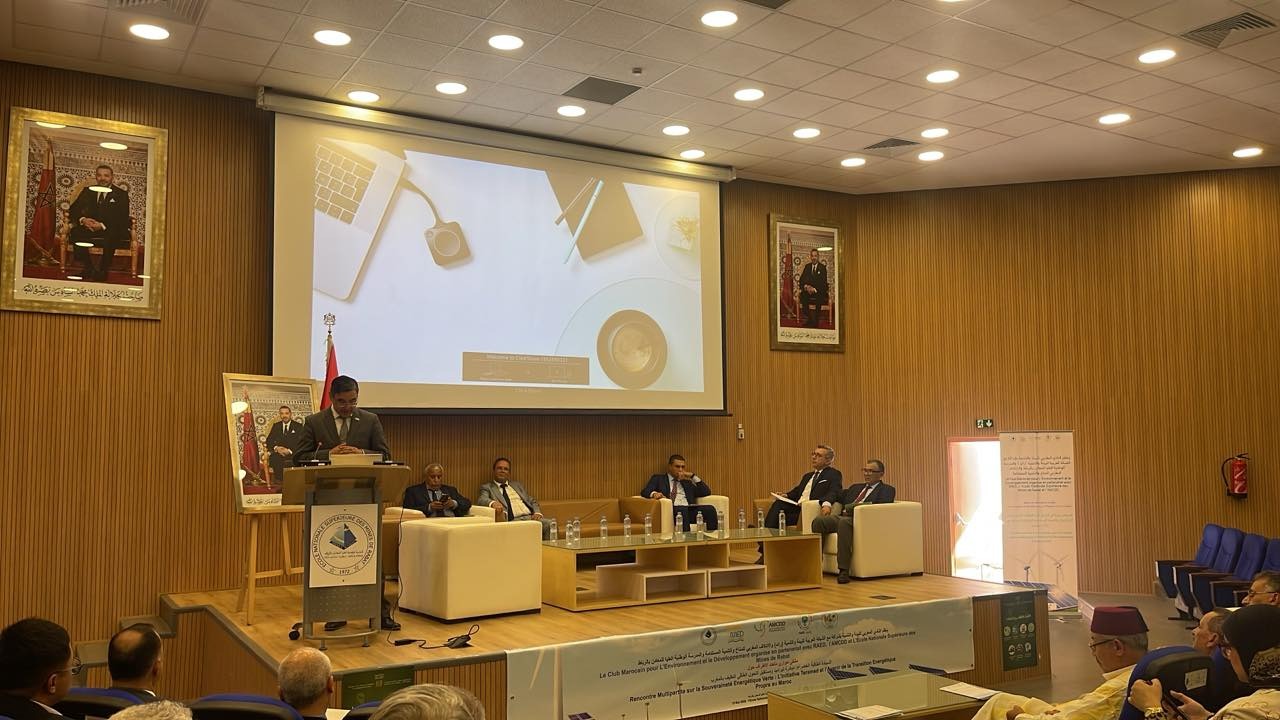
The Arab Network for Environment and Development (RAED) organized a multi-stakeholder dialogue on “Green Energy Sovereignty” and the prospects for the transition towards clean energy in the Mediterranean region. The event was held in partnership with the Moroccan Club for Environment and Development, RAED’s member organization in the Kingdom of Morocco, and the Moroccan Coalition for Climate and Sustainable Development, on 15 May 2026 at the National Higher School of Mines in Rabat, Morocco.
The dialogue brought together a wide range of executive officials, experts, academics, civil society representatives, and private sector actors, reflecting the growing regional interest in accelerating the transition towards a low-carbon economy and strengthening energy security in the region. The event featured an extensive discussion on the future of energy transition in Morocco and across the Mediterranean Basin within the framework of the TeraMED Initiative, with a particular focus on promoting regional integration in renewable energy, improving the efficiency of natural resource use, and addressing the accelerating climate and geopolitical challenges facing the region.
In his opening remarks, Dr. Mohamed Fettouhi, President of the Moroccan Club for Environment and Development, emphasized that the meeting was taking place at a highly critical time, amid global transformations related to energy security, growing demand for clean energy sources, and the accelerating impacts of climate change. He noted that the energy transition is no longer merely an environmental option, but has become a strategic pathway directly linked to achieving sustainable development and enhancing economic and environmental stability.
Dr. Fettouhi further highlighted that Morocco has accumulated significant experience in recent years in the fields of renewable energy and energy efficiency, strengthening its position as a regional actor capable of contributing to the development of a green economy based on low-emission industries, in line with the growing global trend towards reducing dependence on fossil fuels.
One of the key sessions of the dialogue featured a presentation by Dr. Jawad El Kharraz, Coordinator of the TeraMED Initiative and the Mediterranean Clean Energy Network, on the strategic dimensions of the initiative as a regional project aimed at repositioning the Mediterranean space as a global hub for clean energy and green manufacturing.
Dr. El Kharraz explained that the Mediterranean region is now at the heart of global geopolitical transformations, while simultaneously facing increasing challenges, including climate vulnerability, water scarcity, dependence on fossil fuels, and food security risks. He noted that the initiative seeks to transform these challenges into development and investment opportunities by mobilizing finance, developing renewable energy projects, and strengthening energy integration between the northern and southern shores of the Mediterranean.
He added that the TeraMED Initiative aims to achieve one terawatt of renewable energy production capacity by 2030, while mobilizing estimated investments of around USD 700 billion. This could contribute to creating nearly three million new jobs in the fields of solar energy, wind energy, and related green industries.
He also pointed out that the southern shore of the Mediterranean holds substantial solar and wind energy potential, estimated at around 3.5 terawatts. This offers the region a strategic opportunity to become a regional hub for clean energy production and to connect the markets of Africa, Europe, and the Middle East, while supporting efforts to decarbonize the industrial, transport, and household consumption sectors.
Participants affirmed that achieving these goals requires expanding investments in energy infrastructure, strengthening cross-border electricity interconnections, developing policies that support regional energy integration, and broadening public-private partnerships.
The discussions also underscored the importance of supporting green industries linked to the production of green hydrogen and low-emission fuels, as well as strengthening what speakers described as “energy diplomacy” among Mediterranean countries. This is essential to ensuring a just and equitable energy transition that takes into account social and development dimensions and enhances the institutional and human capacities needed to lead this transformation.
The dialogue was held at a time when regional and international calls are increasing to accelerate the transition towards a low-carbon economy in the Mediterranean region, not only in response to global climate commitments, but also as a strategic opportunity to support sustainable development, create jobs, and strengthen economic and environmental security in one of the world’s regions most affected by the impacts of climate change and geopolitical instability.