From Field Trials to Farmers: Boosting Water Productivity and Food Security in Egypt’s Delta
Raised-bed farming and smart irrigation address drought and salinity, delivering a 57% increase in water-use efficiency
As water scarcity and climate change place growing pressure on Egyptian agriculture, a “Living Lab” trial in Sidi Salem, Kafr El-Sheikh Governorate, offers a practical model for improving the productivity of strategic crops while reducing water consumption. Combining sustainable agricultural practices with modern digital technologies, the trial’s final results demonstrated the potential to produce more wheat using less irrigation water, despite the area’s challenging environmental conditions, particularly soil salinity and poor drainage. The findings open new opportunities to strengthen agriculture’s resilience to drought and support food security.
The trial forms part of the ABCDryBASIN project, “Advancing Stakeholder Engagement to Build Resilience to Drought Impacts through Traditional Knowledge and Smart Water Management Tools,” implemented by the Arab Network for Environment and Development (RAED), with the participation of the Faculty of Engineering at Tanta University and funding from the Institute for Water Education in the Netherlands. The project seeks to develop practical water management solutions for vulnerable agricultural areas by combining local expertise with scientific and technological tools and involving farmers in testing practices that could improve water-use efficiency.
Dr. Moharram Fouad El-Bassiouni, Professor of Animal Physiology, an expert in saline agriculture at the Desert Research Centre and the project’s technical consultant, explained that Sidi Salem was selected for the Living Lab because of the interconnected challenges facing the area. These include its location at the downstream ends of irrigation networks, seawater intrusion, high salinity in soils and groundwater, poor drainage and high water tables in some locations. Together, these conditions place additional stress on crops and make it necessary to improve irrigation management to maintain adequate moisture for plants while limiting water waste and salt accumulation around their roots.
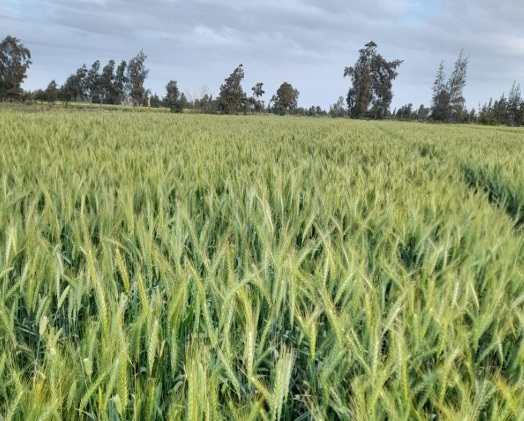
To measure the effects of the new practices, a demonstration field covering approximately 13 qirats was established and managed using an integrated package of agricultural techniques. Its performance was compared with an adjacent 18-qirat field cultivated using traditional methods and a separate 12-qirat field representing prevailing farming practices in the area. All three fields used the same irrigation pump, with a power rating of 5.5 horsepower and a discharge rate of 120 cubic metres per hour, allowing comparisons of water consumption and wheat productivity under different agricultural management approaches.
The demonstration model used laser land levelling to improve irrigation water distribution and reduce losses caused by water collecting in low-lying areas or seeping into deeper soil layers. The land was then shaped into raised beds rather than cultivated on a flat surface. This system channels water through the furrows between the beds, allowing moisture to reach plants while limiting salt accumulation in the root zone. According to the project’s technical report, raised-bed cultivation can save approximately 20–25% of irrigation water compared with flat cultivation, depending on application conditions.
El-Bassiouni added that the intervention also addressed soil properties through the application of compost, mineral fertilisers and humic acid to support plant growth and improve tolerance to salt and water stress. The wheat variety Giza 171 was planted at a seed rate of 60 kilograms per feddan to benefit from its relative tolerance to salinity.
The trial gained additional value through the introduction of smart irrigation using a soil moisture meter. The device helped determine when irrigation was needed based on actual soil moisture conditions, rather than fixed schedules or imprecise estimates. This enabled irrigation to be adjusted to the crop’s actual needs, with particular attention to critical stages of wheat growth, especially heading and grain filling, when water stress can cause a substantial decline in productivity.
Although the demonstration field received seven irrigations during the season, compared with six in the adjacent field and five in the separate traditional field, it recorded the lowest total water consumption per feddan. This difference shows that water conservation does not necessarily depend on reducing the number of irrigations. It also depends on improving water distribution, shortening irrigation duration and timing each irrigation according to crop needs and growth stages.
The comparative evaluation showed that total seasonal irrigation water consumption in the demonstration field was approximately 1,860.6 cubic metres per feddan, compared with 2,400 cubic metres in the adjacent field and 2,040 cubic metres in the separate traditional field. The demonstration model therefore achieved water savings of 22.5% compared with the adjacent field and approximately 8.8% compared with the separate traditional field, despite receiving more irrigations.
This integrated management of water and soil was reflected in wheat yields. The demonstration field produced 20.7 ardabs per feddan, compared with 17 ardabs in the adjacent field and 14 ardabs in the separate traditional field. Straw yields also increased, reaching the equivalent of 29.5 loads per feddan in the demonstration field, compared with approximately 14 loads in the adjacent field and 13.2 loads in the separate traditional field, according to the technical report.
The clearest indicator of the trial’s success, however, was water-use efficiency, measured as the quantity of grain produced per cubic metre of irrigation water consumed. The demonstration field achieved 1.67 kilograms of grain per cubic metre of water, compared with 1.06 kilograms in the adjacent field and 1.03 kilograms in the separate traditional field. These results represent an approximately 57.5% increase in water-use efficiency compared with the adjacent field, highlighting the importance of combining land engineering, smart irrigation and improved plant nutrition to maximise production per unit of water.
These findings are particularly significant given the pressures on Egypt’s water resources and the need to increase productivity on existing agricultural land rather than relying solely on expanding the cultivated area. The trial illustrates how improved water management can contribute to two complementary goals: reducing water consumption and increasing the productivity of strategic crops, thereby strengthening food security in the face of climate change.
The trial also highlights that addressing drought requires more than reducing the volume of water used. It calls for more efficient management of available resources, beginning with improved soil properties and land levelling, and extending to the selection of varieties suited to local conditions, the use of measurement tools to determine crop water requirements, and the provision of water during the most sensitive growth stages. Reducing the number of irrigations without considering plants’ actual needs can lead to water stress and lower yields, while smart irrigation allows a better balance between conserving water and protecting crops.
The results provide a basis for extending the trial to agricultural areas in the northern Delta facing similar conditions of salinity, poor drainage and water shortages. Such expansion would need to account for differences in soil characteristics, irrigation sources and local conditions, with further field applications to verify the findings. It would also require stronger agricultural extension services, training for farmers in the use of soil moisture measurement technologies, and an assessment of the economic viability of laser levelling, raised-bed construction and soil amendments to support wider adoption.
The Living Lab in Kafr El-Sheikh demonstrates that translating scientific solutions into practical field methods is an important pathway towards strengthening Egyptian agriculture’s resilience to drought and salinity. By combining agricultural expertise with modern technologies, farmers can achieve higher productivity from available resources, reduce water consumption and support sustainable agricultural production. The trial offers a model that merits further evaluation and development before being applied in other areas facing similar challenges.