The Jordanian Society for Combating Desertification Launches the First Activities of the TeraMed Initiative in Partnership with RAED
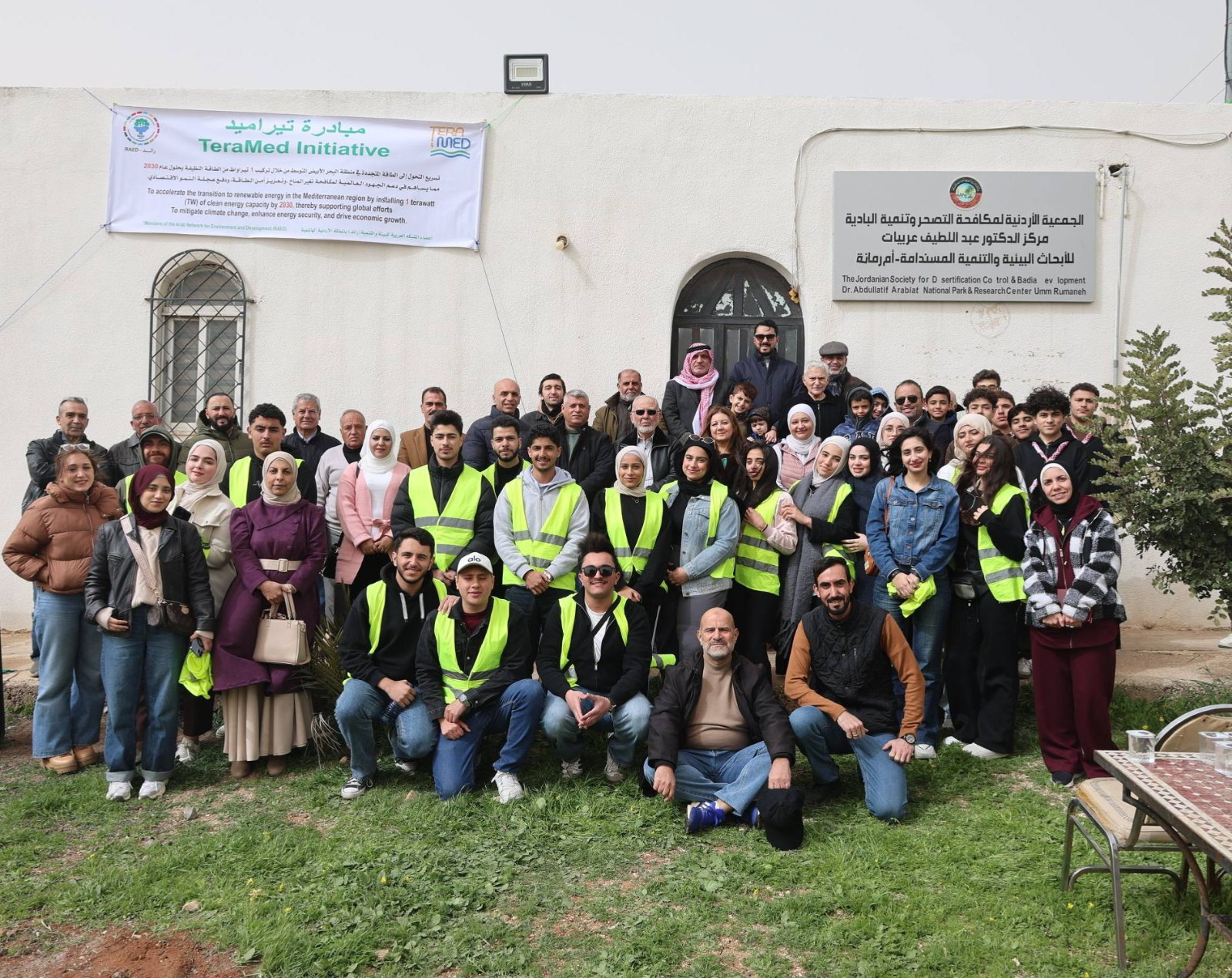
Amid broad community and academic participation, the Jordanian Society for Combating Desertification and Badia Development, in partnership with the Arab Network for Environment and Development (RAED), launched the first activities of the TeraMed Initiative, which aims to double clean energy production in the Mediterranean Basin to one terawatt by 2030.
The launch ceremony of the TeraMed Initiative, hosted by the Abdul Latif Arabiyat Center for Environmental Research and Sustainable Development in Umm Rumana, witnessed strong attendance from faculty members and students of Al-Ahliyya Amman University, the President and members of the New Birain Municipality, representatives of the local community, the President and members of the Federation of Environmental Associations, as well as a number of stakeholders interested in environmental, energy, and sustainable development issues.
The TeraMed Initiative seeks to accelerate the transition to renewable energy in the Mediterranean region and to strengthen renewable energy policies by encouraging governments to adopt supportive regulatory frameworks and legislation, enhancing regional cooperation among Mediterranean countries, and stimulating investment and innovation through attracting private-sector investments and supporting technological advancements in clean energy.
Led by RAED in coordinating civil society efforts in the southern and eastern Mediterranean, the initiative focuses on expanding access to clean energy and improving electricity services in underserved communities, thereby supporting the implementation of national climate action plans.
Engineer Islam Meghaireh, Secretary-General of the Jordanian Society for Combating Desertification and RAED National Coordinator in Jordan, explained that the initiative is being implemented in partnership with several international organizations, foremost among them the International Renewable Energy Agency (IRENA) and the Global Renewable Energy Alliance, in addition to national governments in the Mediterranean region, civil society organizations, and the private sector, including renewable energy companies, as well as regional organizations supporting energy transition initiatives.
Meghaireh noted that all Arab countries that have endorsed the initiative’s implementation action plan fall under the umbrella of RAED. Its implementation involves a wide range of stakeholders, including parliamentarians, government officials, academics, regional and international organizations, financial institutions, private-sector representatives, as well as women’s and youth groups, media professionals, and local champions from across the Mediterranean region.
Implementation efforts are set to cover eight Arab countries in the southern and eastern Mediterranean: Egypt, Tunisia, Algeria, Jordan, Morocco, Lebanon, Libya, and Palestine, within a participatory approach that promotes regional integration in the field of clean energy.
Meghaireh added that the coming period will witness the organization of a series of activities, events, and specialized workshops aligned with the objectives of the initiative, strengthening its presence at both national and regional levels. He noted that these efforts are integrated with Jordan’s national energy strategy, which aims to increase the share of renewable energy to 50% by 2030 by encouraging investments in solar and wind energy projects.
The TeraMed Initiative reflects a practical approach to advancing the energy transition in the region through multi-level partnerships that bring together community-based action and institutional engagement, supporting the achievement of the Sustainable Development Goals and strengthening the regional response to climate and energy challenges.