RAED Launches the First Media Network to Support Achieving the Goals of the TeraMed Initiative in the Arab Region
“Just Energy Transition in the Southern Mediterranean: Opportunities and Challenges”
Adly: The media is a key partner of civil society in ensuring a successful transition to clean energy
At a critical moment marked by an unprecedented acceleration of climate change impacts and energy crises worldwide, the TeraMed Initiative emerges as one of the most ambitious regional frameworks supporting a just and sustainable energy transition in the Southern Mediterranean. The initiative is grounded in broad partnerships among governments, civil society, international institutions and all relevant stakeholders, foremost among them the media, as a primary driver of change.
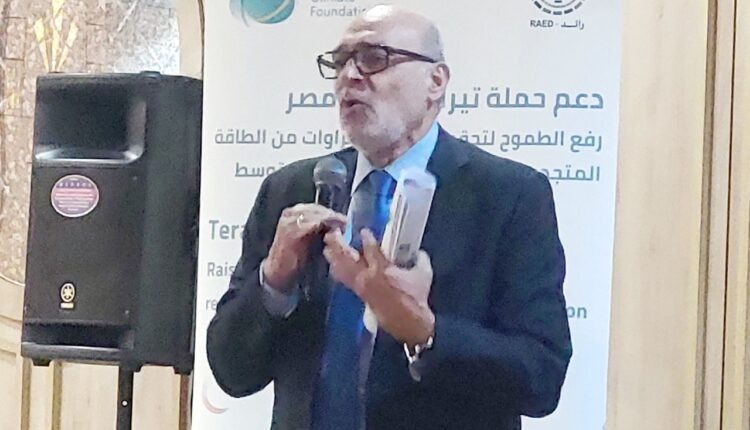
In this context, the Arab Network for Environment and Development (RAED) launched the first specialized Arab media network dedicated to supporting the achievement of the TeraMed Initiative’s goals. The launch took place during a virtual seminar held on Monday, 5 January 2026, entitled “The TeraMed Initiative and the Just Energy Transition in the Southern Mediterranean: Opportunities and Challenges,” with the participation of a distinguished group of media professionals and climate and energy stakeholders from across the Arab region.
Dr. Emad Adly, General Coordinator of RAED, emphasized that the current year marks the effective launch of the second phase of the TeraMed Initiative, a phase he described as pivotal, as it builds on the achievements of the first phase and moves the initiative from the realm of vision and planning toward broader horizons of implementation and tangible impact. Dr. Adly stressed that the media should not be viewed merely as a conduit for information, but rather as a genuine partner in shaping public awareness, mobilizing societal support and influencing public policies related to the transition toward renewable energy.
He further explained that TeraMed is the first regional initiative of its kind aimed at accelerating the deployment of renewable energy across the Mediterranean basin by advancing pathways for a just energy transition through national policies and plans, green financing mechanisms and the active engagement of civil society organizations. He added that the core message of the initiative lies in mobilizing the efforts of all partners around an ambitious shared goal: achieving one terawatt of renewable energy capacity in the Mediterranean region by 2030, building on the region’s vast potential in solar, wind and other clean energy sources.
For her part, Ghada Ahmadein, Programs Director at RAED, noted that what gives TeraMed its distinctive strategic dimension is its early recognition of the central role of both the media and civil society in ensuring a successful just transition to clean energy. She pointed out that the initiative’s second phase will place the media at the heart of implementation, serving as a bridge between political vision and practical application. She added that forthcoming media campaigns will aim to build a positive and compelling narrative directed at both the public and decision-makers through collaborative partnerships and initiatives, including a new initiative known as “Local Champions.”
As reflected in the interventions of several seminar participants, climate change is no longer a theoretical concern or a deferred policy issue; it has become a concrete crisis exerting pressure on economies, societies and states alike, necessitating a rethinking of development models and energy security frameworks. In this context, renewable energy has emerged as a cornerstone of the global response to reducing emissions. However, the success of this transition ultimately depends on societies’ ability to understand and engage with it, a role in which the media plays a decisive part by translating scientific knowledge into public awareness and actionable policies.
Since the adoption of the Paris Agreement in 2015, media discourse on climate change and the renewable energy transition has evolved significantly, both in terms of the volume of coverage and the depth of analysis. Digital platforms have contributed to conveying scientific data and linking it to its economic and social contexts, elevating climate issues from a narrow technical domain to the forefront of public debate. Discussions of renewable energy are no longer confined to technical considerations alone, but now encompass energy sovereignty, job creation, social justice, and regional stability.
Within this broader context, the TeraMed Initiative, officially launched in October 2024 during Cairo Sustainable Energy Week, was presented as a regional model demonstrating how energy policies can be transformed into a cross-border collective endeavor. Led by RAED in partnership with the Union for the Mediterranean and the International Renewable Energy Agency, the initiative aims to install one terawatt of clean energy capacity by 2030 through harnessing the immense solar and wind potential of Mediterranean countries.
Several participating journalists also addressed the challenges facing environmental media, notably political polarization, the spread of misinformation and the superficial treatment of energy transition issues that reduces them to generic slogans, in addition to the weakness of specialized investigative journalism capable of unpacking legislative and financial barriers and complex vested interests.
The seminar concluded that the battle for a renewable energy transition will not be won by technology alone, but by a compelling media narrative capable of persuading societies of the feasibility and fairness of change. The TeraMed experience underscores that the future of energy in the Mediterranean, perhaps globally, will depend on responsible and more informed media, turning the 2030 horizon into a shared civilizational milestone, where the costs of transition become an investment in a safer, fairer future and an irreversible collective choice.