Traditional Knowledge and Smart Water Management: Innovative Solutions to Confront Drought in Egypt’s Delta
Consultative Meetings to Strengthen Water User Associations: Strong Executive Presence and Diverse Community Representation
Amid the growing challenges facing Egypt’s Delta due to the escalating impacts of drought and declining water resources, a range of qualitative initiatives has emerged that combine traditional knowledge with smart water management tools, to develop sustainable solutions grounded in local experience and modern technology. Among these initiatives is the project “Boosting Stakeholders’ Engagement to Stimulate Drought-Resilient Impacts through Traditional Knowledge and Fair Smart Water Management Tools (ABCDryBASIN)”, implemented by the Arab Network for Environment and Development (RAED), with funding from the International Water Education Institute (IHE). The project aims to strengthen the capacity of local communities in Delta governorates to adapt to drought and enhance their resilience to climate change.
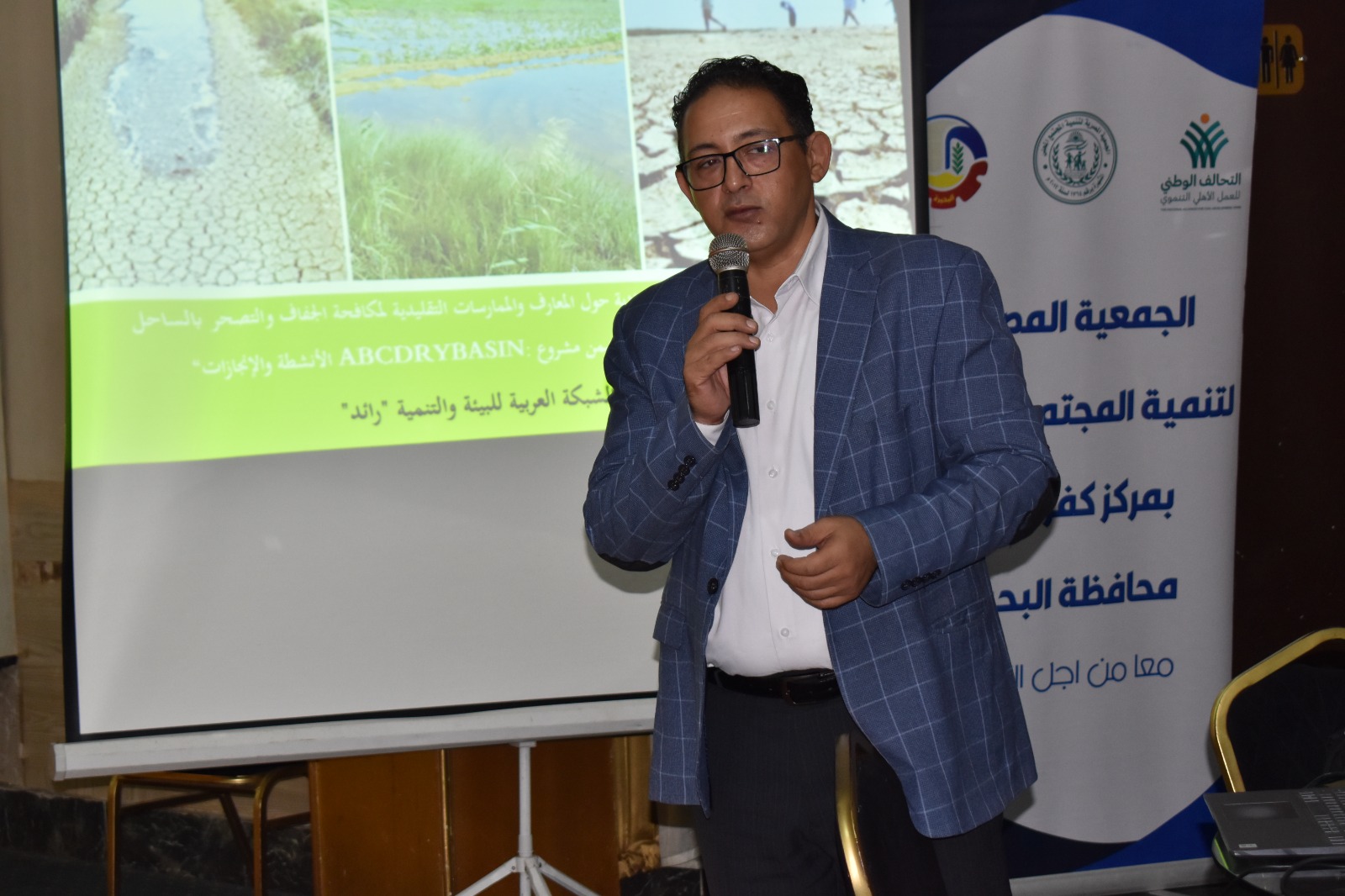
Within the framework of the project’s activities, RAED organized a series of consultative meetings in Kafr El-Sheikh and Beheira Governorates under the title “Mechanisms for Stimulating the Performance of Water User Associations and their Impact on Mitigating Drought Effects.” These meetings were a continuation of the outcomes of the first consultative meeting held in Gharbia Governorate in late August 2025, in cooperation with the Faculty of Engineering at Tanta University, which addressed the “Impacts of Drought on Food Security and Available Opportunities and Alternatives.”
The first meeting was held in Kafr El-Sheikh Governorate on Monday, 13 October, at the Cultural Club headquarters in Sidi Salem, while the second meeting was hosted by Damanhour City in Beheira Governorate on Thursday, 30 October, at the Agricultural Club Hall. The meetings were marked by strong participation from relevant executive authorities, including leaders from the Directorates of Water Resources and Irrigation, Agriculture and Land Reclamation, Social Solidarity, the Environmental Affairs Agency, also, the Nile Media Centers, in addition to representatives of local sustainable development forums, a number of farmers and officials from Water User Associations in both governorates. This diversity of participants created a fertile environment for dialogue and the exchange of expertise among the various stakeholders involved in water management at the local community level.
The sessions discussed key themes related to the governance of Water User Associations within each governorate and their role in promoting sound water resource management, in a manner that ensures sustainability and equitable distribution. Participants exchanged views on assessing the performance of the associations, the challenges they face and practical ways to enhance their efficiency, whether through building technical and administrative capacities or by stimulating community participation in water resource management. Several officials and farmers emphasized the importance of supporting these associations as a vital link between government authorities and local communities, stressing that improving their performance would directly contribute to reducing the impacts of drought and enhancing water-use efficiency in agriculture.
The consultative meetings concluded with a set of recommendations aimed at improving the performance of Water User Associations and strengthening coordination among concerned entities. Key recommendations included: direct cooperation with the Directorates of Water Resources and Irrigation to hold a series of specialized meetings with the associations in each governorate to discuss current challenges and available opportunities; activating the use of social media platforms as tools for coordination and information exchange among association secretaries and members to enhance communication and accelerate decision-making; and strengthening networking among associations across the three targeted governorates (Gharbia, Kafr El-Sheikh, and Beheira) through joint workshops and experience-sharing initiatives.
On the sidelines of the meetings, members of the local sustainable development forums in Kafr El-Sheikh and Beheira presented a set of practical proposals to raise awareness of the importance of rational water use and the conservation of natural resources. Participants agreed to develop a comprehensive awareness-raising plan, in coordination with executive leaders, targeting youth, women, school students, youth centers and local media to implement community initiatives aimed at promoting a culture of efficient water use and addressing negative behaviors associated with waste and mismanagement.
The participating executive leaders expressed strong responsiveness to these initiatives and announced their full readiness to engage in the implementation of awareness and technical support plans. They also called for intensifying activities on a regular and sustainable basis, under the patronage of the governors, to ensure the continuity of impact and the achievement of the desired outcomes.
For its part, the project team affirmed that the core philosophy of ABCDryBASIN is based on integrating the traditional knowledge of farmers and local communities, accumulated over generations of experience in dealing with drought, with modern scientific tools, such as smart monitoring systems, early warning systems and water data analysis. This integration aims to establish a more equitable and efficient water management system that strengthens the capacity of Egypt’s Delta to confront climate change while ensuring both water and food security simultaneously.